FRIDAY NIGHT IN SAN FRANCISCO — Three Guitars, One night, for eternity.

Updated: May 16

There are recordings that transcend time. Born of an improbable convergence — three men, a stage, a December night — their resonance carries across decades without ever fading.
Friday Night in San Francisco is one of them. Forty-five years after its release, this album remains an absolute reference: musical, technical, emotional.
Three destinies, one instrument.

©Sophie Le Roux
Paco de Lucía — The Andalusian flame.
Francisco Gustavo Sánchez Gomes, known as Paco de Lucía, was born in 1947 in Algeciras, in the province of Cádiz. He grew up in a household where flamenco was not a choice but a condition of existence. His father, Antonio Sánchez, taught him guitar from childhood.
At sixteen, he recorded his first album.
At twenty, he redefined the possibilities of the flamenco guitar: his picados were delivered at a speed and precision that left purists speechless. But Paco refused to be confined to a single style. He integrated bossa nova, jazz, and classical music into his flamenco language, creating what would come to be called nuevo flamenco.
His collaboration with singer Camarón de la Isla is a founding chapter of twentieth-century Iberian music. When John McLaughlin crossed his path in Paris — where McLaughlin heard a piece by de Lucía on the radio and immediately decided he had to meet him — their dialogue became instantly apparent.

Al Di Meola — Mediterranean lightning.
Born in 1954 in Jersey City, New Jersey, into an Italo-American family, Al Di Meola is the youngest of the trio. His training is academic: he studied at the Berklee College of Music in Boston.
At barely nineteen, he joined Return to Forever, Chick Corea's group, and immediately made his mark — a staggering picking speed, mechanical precision, a palette blending jazz fusion, flamenco, and Mediterranean music.
His solo albums Land of the Midnight Sun (1976) and Elegant Gypsy (1977) established him as a defining figure in both acoustic and electric guitar. His Mediterranean sensibility drew him naturally toward the flamenco world of Paco de Lucía. The encounter with McLaughlin was a collision of generations and aesthetics — a collision that produced light.

John McLaughlin — The electric pioneer
Born in Kirk Sandall, Yorkshire, in 1942, John McLaughlin is the eldest of the trio and arguably the one whose journey is the most breathtaking. A self-taught guitarist formed in the British blues, he cut his teeth in London clubs before joining Miles Davis for the Bitches Brew sessions (1969), the founding album of jazz fusion.
With the Mahavishnu Orchestra, he pushed the electric guitar into territories then unexplored — polyrhythm, speed, dissonance, Hindu spirituality.
With Shakti, he made the reverse journey: he set aside electricity for acoustics, immersed himself in Indian classical music, entering into dialogue with L. Shankar's violin and Zakir Hussain's tabla.

© Jean-Claude Aunis
It was this crossing that would lead him to the Warfield Theatre in 1980: a guitarist who had proven everything on stage and was now searching for the purity of the acoustic gesture.

Meeting of the spirits
Everything began in Paris. McLaughlin heard a piece by Paco de Lucía on the radio and decided he had to work with him. Paco de Lucía happened to be in Paris at the same time. They played together. The chemistry was immediate, but both felt a third voice was missing.
The trio first formed with Larry Coryell, an American jazz fusion guitarist. The collaboration never fully took hold. Al Di Meola then joined the Guitar Trio. In 1980, after months of preparation, the group embarked on a two-month tour across Europe and the United States. Each musician played his own compositions as well as those of the others. No fixed setlist. No safety net.
The dialogue was improvised within the pre-established rules of the game, among three musicians who read each other at the speed of strings.
The last two dates of this tour took place in San Francisco, at the Warfield Theatre, on December 5 and 6, 1980.

La nuit du 5 décembre 1980 — La capture
The album was recorded during the concert on Friday, December 5, 1980 at the Warfield Theatre in San Francisco, with the exception of Guardian Angel, which was recorded and mixed later at Minot Sound, White Plains. The tapes from December 6 would be exploited later on the album Saturday Night in San Francisco..


The decision to record both nights fell to Al Di Meola. Di Meola commissioned Tim Pinch of Pinch Recording to carry out live recordings using a remote mobile rig. The recording chain was remarkably rigorous for a live concert of that era.
For each guitarist, Tim Pinch placed two microphones on a single stand: one microphone positioned near the soundhole of the instrument, a second at the neck. Since the acoustic guitars were amplified — the size of the hall required it — a direct feed from each amplifier to the mixing console was also captured. Several microphones were then aimed at the audience to capture immediate reactions, while others were placed toward the rear of the hall to reinforce the acoustic ambiance of the venue.

Sixteen tracks for three musicians. Precise, rigorous, conceived to preserve depth of field and the naturalness of timbres. The mobile recording was made on a 3M tape machine. The original master disc was cut in New York. The credited engineers are Tim Pinch, Tom Pinch, and Rex Olsen.
The mix was entrusted to Roy Hendrickson. Hendrickson produced a remarkable piece of work assembling these sixteen channels into a coherent document of the concert, capturing not only the trio's playing but also the acoustic landmarks of the hall, which give the recording its ethereal character.

Bande Master originale 16 pistes du lendemain 6 /12/80
Le programme du 5 — cinq titres, cinq univers
The album's tracklist is a journey through styles and sonic geographies.
Mediterranean Sundance / Rio Ancho, eleven minutes thirty seconds, opens the record. A composition shared between Di Meola and de Lucía. The duo winds its way between Andalusian and jazz idioms, the two guitarists answering each other with the precision of duelists.
Short Tales of the Black Forest by Chick Corea — performed by McLaughlin and Di Meola — reveals their ability to inhabit a complex jazz harmonic world with disarming lightness.
Frevo Rasgado by Egberto Gismonti brings McLaughlin and de Lucía together. Brazilian rhythm enters into dialogue with flamenco in a state of permanent tension.
Fantasia Suite gathers all three guitarists in a trio format. This is the album's peak: the confrontation of three aesthetics within a shared space.
Guardian Angel by McLaughlin, the only studio-recorded track, closes the album on a more contemplative note.
The instruments used that evening were worthy of their players. Paco de Lucía played a traditional Spanish flamenco guitar, with a spruce top and cypress back and sides, tuned in flamenco E. John McLaughlin and Al Di Meola played Ovation electro-acoustic guitars.
Equipment and Recording Configuration
Analogue Recording: The concert was captured on a 16-track tape machine.
Mobile Studio: The recording was made via a remote truck parked directly in the street in front of the venue.
Technical Priority: The objective was to obtain clean tracks, free of any distortion or clipping — which was the major challenge of the analogue era.
Microphone Setup — identical for both evenings to maintain the same sonic signature:
Guitars: Three direct inputs (D.I.) combined with acoustic microphones placed in front of the guitars, for each musician.
Audience and Ambiance: A four-microphone system to capture the energy of the hall — two microphones at the front to capture immediate reactions (shouts and whistles), two microphones aimed toward the rear of the hall to capture the natural reverberation of the venue and its overall acoustic.
Performance Conditions: At the time of the San Francisco recording, the three musicians had been playing together every night for two consecutive months. Al Di Meola explained that they chose to record the last two dates of the tour because that was when they were "the hottest" — technically and musically. The capture particularly succeeded in conveying the "massive" quality of the sound, thanks to the blend of close-up and ambient microphones.
These technical conditions allowed engineers, forty years later, to extract a clarity and note articulation judged exceptional by today's standards.
The Commercial Destiny — One and a Half Million Reasons
The album was released on August 10, 1981 on Columbia Records, after Al Di Meola persistently lobbied the label until it agreed to put it out. It became a reference recording, crossing the two-million copies sold mark.
For a record of uncompromising acoustic guitars — no vocalist, no radio-friendly format — the figure is staggering. It is explained by the convergence of several factors: the reputation of all three artists among jazz and fusion audiences, the discovery of flamenco by an American public then largely unexposed to it, and a sound quality that immediately made the album a demonstration tool in hi-fi shops and audiophile shows.
Jazz critic and author Walter Kolosky wrote that the album could be considered the most influential of all live acoustic guitar records ever made.
The original Columbia pressing (1981, CBS) remains a reference for purists. Its natural dynamics and tonal balance are difficult to surpass at a reasonable price on the secondhand market.
The Sony HDCD CD version (reissue, 1990s) improves the digital resolution of the standard edition, with careful remastering.
The ORG (Original Recording Group) 180-gram 45 rpm edition long stood as the modern vinyl benchmark for this album, before selling out.
Impex Records has published two reference editions: first a 180-gram 33 rpm pressing mastered by Bernie Grundman from the original analogue master tapes, limited to 3,000 numbered copies and pressed at RTI in California — then a double 45 rpm 180-gram vinyl that raises the level of restitution still further.

last pressing remaster from master tapes analog original & 45 rpm Impex Records.
Comparisons with the original Columbia pressing, the Sony Gold CD reissue, the Sony K2 SACD, and the ORG edition have led many critics to consider the Impex 45 rpm superior to anything previously heard in terms of dynamics, immediacy, and timbral purity.
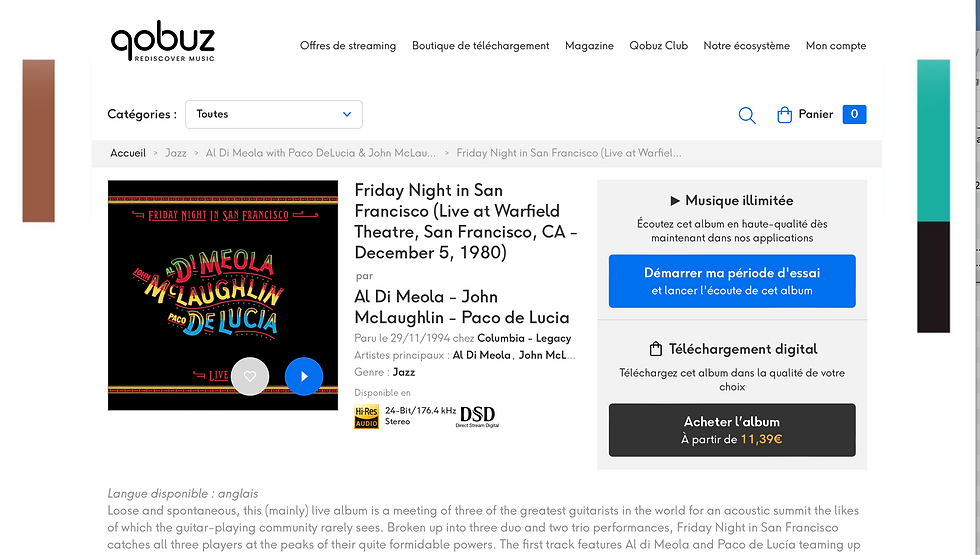
In high-resolution streaming, the album is available on Qobuz in 24-bit / 192 kHz. The DSD version, drawn from the same master tapes, offers a credible alternative for audiophiles equipped with network players and compatible DACs.
The Recording as Counterpoint to the Age of AI
In 2026, the question arises with particular sharpness. Algorithms generate music. Platforms offer personalised accompaniments. Models imitate styles with increasing precision.
Friday Night in San Francisco answers this without words.
What is heard on this album cannot be simulated, because it is not first and foremost a question of notes. It is a question of risk. These three men were playing in front of an audience, without a safety net, without the possibility of a retake.
Every variation of tempo, every silence, every sudden acceleration from Di Meola, every breath from de Lucía between two picados — all of it is irreplaceable because all of it was perishable. A live performance is a singular event in physical time. The recording is its fossil trace.
The tension one hears in Mediterranean Sundance is the tension of two men listening to each other in real time, anticipating and reacting. No neural network can reproduce the bodily dimension of this playing: the weight of the right hand on the strings, the warmth that builds under the fingers, the fatigue that accumulates through the concert and paradoxically sets something free.
Bonus: In 1996, here they are again, reunited in Paris at the Festival de Jazz de la Villette, to the great joy of guitar aficionados.

Heartfelt thanks to Sophie Le Roux, photographer at the Académie du Jazz, for this unique photograph and for the magnificent portraits of Paco, John, and Al Di Meola that illustrate this article.
For more than forty years, this album has remained an unmissable reference in hi-fi system demonstrations at audio shows around the world. It is one of those rare records you can place on a turntable at any hour and in any mood, and which always meets the moment.
The passing of Paco de Lucía in February 2014 added a further dimension to this sonic document. What one hears no longer exists in this form in the real world. McLaughlin and Di Meola are ageing.
The night of December 5, 1980 at the Warfield Theatre is, for its part, definitively fixed in its sixteen tracks. It will remain what it is: the testimony of three artists at the summit of their art, caught in the moment, without retouching, without editing, without algorithm.
That is precisely why it still matters. And why it always will.
Listening recommendation: Impex Records 180g / 45 rpm edition, mastered by Bernie Grundman from the original analogue tapes. For network systems: DSD 64 or PCM 24-bit / 192 kHz file via Qobuz.

If this article was helpful, a simple "Like" below helps me continue these tests for the community!